ANSWER ENGINE OPTIMIZATION(AEO)AND HOWIT DIFFERS FROM SEO
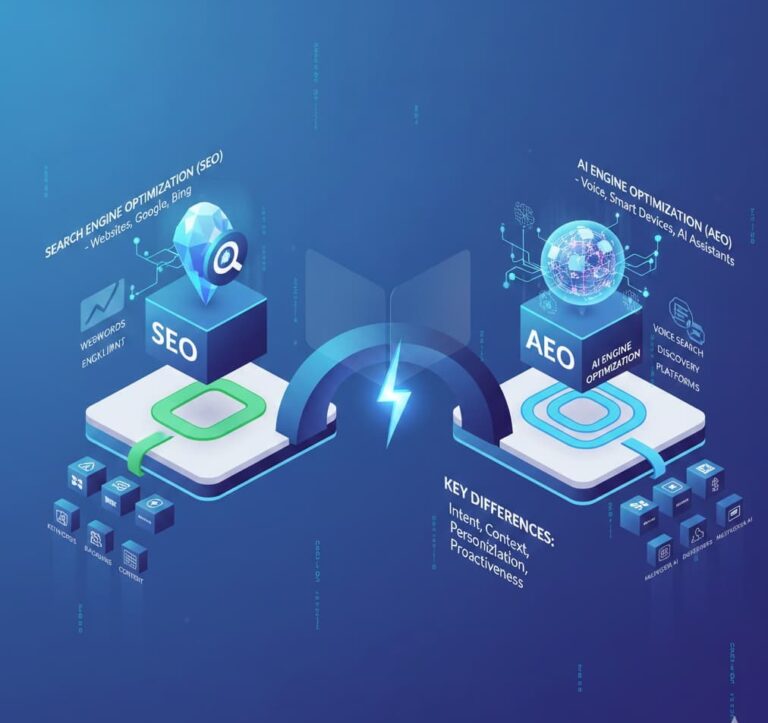
The foundational philosophy of digital marketing has undergone a radical metamorphosis, moving away from the “Search Engine Optimization” era—which focused on the art of the click—and toward “Answer Engine Optimization,” which prioritizes the art of the answer. In the traditional SEO model, success was defined by a brand’s ability to appear in a list of results, acting as a digital signpost that persuaded a user to navigate away from the search engine and onto a private domain. This created a symbiotic relationship where search engines provided traffic in exchange for content. However, in 2026, this symbiosis has been disrupted by the rise of Large Language Models and Generative AI Overviews that aim to satisfy user intent without a single click. AEO is the strategic response to this “Zero-Click” reality; it is the process of structuring information so clearly and authoritatively that an AI agent—be it Gemini, GPT-5, or a specialized vertical assistant—selects your specific data to synthesize its final response. While SEO relied heavily on keyword frequency and the volume of external backlinks to signal relevance, AEO relies on “entity intelligence” and “semantic proximity,” requiring marketers to prove that their brand is not just a source of information, but the definitive authority on a specific topic. This shift requires a psychological pivot for content creators: we are no longer writing to entice a human to read a 2,000-word essay; we are writing to provide the “Atomic Unit of Truth” that an AI can extract in milliseconds. To ignore AEO is to become invisible in the very place where most consumer journeys now begin and end: the chat interface.
To bridge the gap between traditional SEO and AEO, the technical execution of content must evolve into a format that AI crawlers can ingest with high mathematical confidence, a process that goes far beyond meta-descriptions and alt-text. In the AEO landscape, the “Chunking” of content is the new gold standard, where information is organized into modular blocks—definitions, step-by-step processes, and data tables—that are specifically designed for machine extraction. This is supported by an aggressive implementation of advanced Schema Markup, specifically JSON-LD, which acts as a translator between the messy nuances of human language and the rigid requirements of a knowledge graph. Unlike SEO, where a long-form blog post might wander through anecdotes to keep a human engaged, AEO-driven content uses a “Direct-Answer” syntax, leading with a concise, factual statement of approximately 50 words that answers the primary query immediately. This is followed by what is known as “Information Gain” evidence—proprietary data, unique case studies, or expert insights that haven’t been recycled from other websites—because AI models are increasingly programmed to ignore “me-too” content that offers no new value to their training sets. Furthermore, the concept of “Speakable” schema has gained prominence as voice-activated AI agents become the primary interface for local and transactional searches. Marketers must now optimize for the “ear” as much as the “eye,” ensuring that their most critical brand promises are phrased in natural, conversational cadences that sound authoritative when read aloud by a virtual assistant. This technical rigor ensures that when an AI “reasons” through a query, your content is the most frictionless path to a high-confidence answer.
The most jarring change in the transition from SEO to AEO is the total recalibration of Key Performance Indicators (KPIs), as the “Click-Through Rate” (CTR) loses its status as the North Star of digital success. In a world where AI provides the answer directly on the search page, organic traffic to a website may actually decrease while brand influence and market share simultaneously increase. This paradox forces marketers to look at new metrics, such as “Citation Share”—the frequency with which your brand is cited as a source in AI-generated summaries—and “Sentiment Weight,” which measures how favorably an AI model describes your products when asked for a recommendation. Traditional SEO tools are being replaced by “Generative Visibility” dashboards that track a brand’s presence within the latent space of various LLMs, identifying where the AI has a “knowledge gap” about your services and where it is currently favoring a competitor. This new era also sees the resurgence of “Owned Media” and community-building, as the loss of search traffic makes the email list and the private community more valuable than ever before. Brands are realizing that while AEO wins the “top-of-funnel” answer, deep-dive SEO and high-quality long-form content are still required to convert those users who need more than just a quick fact. Therefore, the strategy for 2026 is not to abandon SEO, but to use it as the foundation for AEO, creating a dual-track system where SEO builds the long-term domain authority and trust signals that allow your AEO “answer blocks” to be trusted by the AI. Ultimately, the goal is to create a digital footprint so distinct and authoritative that the AI has no choice but to mention your brand, ensuring that even in a zero-click world, your voice remains the loudest in the room.
https://shorturl.fm/gfsx6
https://shorturl.fm/R1sMJ
https://shorturl.fm/pykRu
https://shorturl.fm/Zk0o7